Monday, June 08, 2009

City Maps and the Height Regulation

This map shows the results of Resolution 1731, proposed in December 2007. The different colors signal different heights permitted in different areas of the city; these detailed heights vary even within the same colored zone, and are printed on larger-scale maps that accompanied this one. Of particular interest is Zone 8 (purple), which specifies minimum heights ranging from e.g. 64 meters to 129 meters. I accessed this map from the St. Petersburg city planning website. The maps took a while to download, but they are freely available-- which, it should be noted, is a significant public service.
This map shows some of the prestige projects proposed or underway around Vasilievsky Island in the Neva delta (located at the center of the city map above). The yellowish areas at center right are the Peter and Paul Fortress (top) and the Winter Palace (center); you can see how near the center some of the projects are.

This map shows some of the projects proposed to the east of the historic center. The Stockmann Shopping Center is actually under construction after the demolishing in fall 2006 of a historic building at the top of Nevsky Avenue on Vosstaniya (Uprising) Square.

St. Petersburg Height Regulation

The following paragraphs are an excerpt from an article that will be published in the December 2009 issue of the International Journal of Urban and Regional Research. I will remove this post once that article becomes available online and I can provide a link to it. Meanwhile, it is important for the blog to clarify the controversy around the Height Regulation.
***

The original Height Regulation was established in St. Petersburg during the nineteenth century and was observed throughout Soviet times. Its fundamental tenet is that no building in the historical center may exceed the height of the cornice of the Winter Palace (24 meters), except for churches and the Admiralty. Its effects were extended over the rest of the city via a corollary that no building be visible from the Neva River embankment or interrupt the “horizontal silhouette” created by the effect of low buildings extending around the expanse of the river; permitted heights vary from district to district. During the 1990s, citizen outcry based on the Regulation successful prevented construction of a skyscraper on the western edge of Vasilievsky Island; Academy of Sciences member and Russian literature scholar Dmitry Likhachev, the city’s “conscience,” warned residents to preserve the city’s horizontality and low skyline.
Far from just a romantic ideal, the Height Regulation was seen as a barometer of development and a safeguard for the character of many residential neighborhoods. In the regulatory chaos of the 1990s and early 2000s, numerous buildings stretched the limits of the Regulation. Extra height and density strained the infrastructure for water and other city services; also, a building that exceeded the Regulation by just a few meters could block the legislated quantity of sun in a courtyard or change the use profile of a neighborhood– that is, change the landscapes on which people built their notions of a good society and social space. Planner Vladimir Roshchin explained this relationship between functional zones and height regulations, noting that in the first version of the Rules (prior to initial citizen comment in fall 2006), certain rezonings would allow heights over 5 stories in some residential areas and “people were afraid precisely of this. … Where there is a possibility to preserve the current height, we’ll preserve it” (Roshchin Interview, 2006).
During the October 2006 hearings on the Rules, restrictions on building heights emerged as a key way that residents sought to track the quantity of building in their districts and the type of new construction (such as hotels or malls) that officials planned to permit. The Rules were supposed to include an updated Height Regulation. Roshchin’s words, in fact, indicate an intended compromise between existing heights and opportunities for growth.The Gazprom project negated the terms of this compromise. In November 2006, the effective regulations for height on the Okhta-Center site would allow nothing higher than 42 meters, 48 meters in case of proving extreme need (Delovoi Peterburg, 11-9-06; 4-28-04). ... Yet Miller openly insisted that the building could be no less than 300 meters tall, and the height of the winning design was 396 meters. Newspapers immediately began to report rumors that officials planned to abrogate the Height Regulation entirely in order to enable the Gazprom project to go forward; this would be a precedent that would enable further violations of the Regulation in other places (St. Petersburg Times, 1-12-07; 9-7-07).
...height (just as elsewhere in the world) signals prestige and global economic sway.
... The precise Height Regulation in effect in November 2006 was Resolution No. 648, passed by the city Legislative Assembly (under Matvienko) on 4 April 2004, referred to as the “Temporary Height Regulation” since a new one was expected to emerge with the new Master Plan. As implied above, the Master Plan document was framed generally and did not include such details of construction parameters; the Rules on Land Use and Construction included maps with a range of zones indicating intended use, but permitted heights remained unclear; this left the 2004 Regulation in force. Meanwhile, throughout 2007, the Rules were discussed and lobbied at KGA but did not advance to the Legislative Assembly. On 28 December 2007, a new Height Regulation was passed in that body as Resolution No. 1731 – by phone vote, or “poll,” as newspapers reported – without the required public consultation. City residents were first made aware of this new version at the hearing on 14 January 2008 for the Temporary Construction Permit specifically for Okhta-Center. A map appended to the Resolution (available on the city website) designates a new range of zones with greatly increased heights throughout the city... This new version allows a height of 100 meters at the Okhta-Center site. [see next post] ... The wording of the Resolution invalidates the Temporary Regulation of 2004; the resolution itself reportedly took effect in April 2008, but a note on the city website still stated in July 2008 that it had not.
In any case, as of autumn 2008 neither the Rules nor the Resolution were yet law. Resolution No. 1731 reportedly constituted a kind of appendix on height for the Rules; these were finally sent to the Legislative Assembly on 2 July 2008, with the intention of considering them in September 2008. However, according to Boris Nikolashchenko, head of the working group for the Master Plan, he has an order to reformulate the height parameters even after the submission of Resolution 1731 to the Assembly (Novaya Gazeta, 7-24-08). Public pressure on the city administration has again increased in light of a scandal that broke out in June 2008 after a published photograph “suddenly” showed how a new building in the center of Vasilievsky Island could be clearly seen behind historical landmarks when standing on central city bridges. In January 2008, Nikolashchenko was quoted as saying, “Everything is done in order to push through the irresponsible project for the Okhta-Center skyscraper. The authorities don’t consider the public (obshchestvennost′) at all. It wasn’t like this even in Soviet times. … In 2004 everything was very democratic and open” (Novaya Gazeta, 1-21-08).
[end excerpt]

Wednesday, June 03, 2009

Street Activism (written 10 September 2007)

On Saturday, September 8, the third of three large demonstrations this year took place in St. Petersburg, Russia. A locally produced online newspaper put the number of demonstrators at 1500; the few Western media outlets who gave the demonstration brief coverage had numbers that ranged from 2000 to 4000. The organizers had expected more than 5000 people. As has happened before, Russian observers of the demonstration have concluded that smaller-than-expected numbers mean that the causes represented by the demonstrators have little resonance with the public at large.

The most prominent of the “causes” is opposition to the proposed skyscraper that would be headquarters for the Gazprom corporation. The skyscraper was announced in summer 2006 and Gazprom CEO Alexei Miller awarded design rights to a British firm in early December 2006; the struggle between proponents and opponents has continued since then. Opponents have appealed to native Petersburgers’ love of their historical city center and horizontal skyline. After all, this is the city where the first large demonstration against Soviet policy took place in the late 1980s over a proposal to demolish a building where a beloved nineteenth-century poet once lived (just a friend of the more famous Pushkin); this was a key moment in the glasnost movement in St. Petersburg. Those who want to use the Gazprom issue to whip up local sentiment can’t be blamed for thinking they could recapture some of that spirit. Prominent city architects, art historians, local politicians, and even the renowned film director Alexander Sokurov have spoken out against the skyscraper. Those who favor the project say that they want to see Petersburg become a modern, vibrant city; those who oppose it fear that the city will lose its UNESCO status as a World Heritage Site in particular, and in general, lose its soul. But Gazprom isn’t even the main issue.

The Gazprom skyscraper indeed raises some serious questions about how things are happening in the city. We don’t hear much about the transportation problems that the skyscraper would create, in a city where underground parking is often prohibitively expensive or inadvisable due to underground rivers and marshy ground. Depending on your taste, it is just the wrong building to help Petersburg take a big step into the 21st century. But even Russian politicians who think they can unite democratic opposition behind the opposition to Gazprom are missing the real story of grassroots civil society development.

First, there’s transportation. The city wants the building to make St. Petersburg more vibrant and modern, but it hasn’t succeeded in building its ringroad highway around the entire city; the “ring” only serves the eastern side, and suffers from chronic traffic jams caused largely by inefficient insurance regulations. Even more importantly, Gazprom has become a convenient rallying point for city residents of all ages who are frustrated with nontransparent construction practices that have destroyed neighborhood parks and in some areas tried to make residents responsible for the bill to demolish their own buildings so that new, more expensive housing can be built in their place.

The Gazprom issue has been such a tempting one for would-be political organizers in St. Petersburg because it represents so many neighborhood-level problems writ large. The very same challenges with inadequate infrastructure or nontransparent resettlements and transactions have brought together residents in many different districts of the city – usually into small, isolated bands of people who are upset enough to spend their time studying city code, writing letters, speaking to reporters, and attempting to get their story out. When they can, they try to attend each other’s demonstrations (which usually must remain small, due to recent requirements that any public demonstration that does not first obtain a permit must not exceed five people). Sometimes, when I interviewed activists from different districts in fall 2006, I was the first person to pass along phone numbers and put them in contact with each other.

It is tricky right now to evaluate phenomena of Russian “civil society.” Those who participate do not look like successful American protesters or political activists, and so perhaps prominent American commentators are reluctant to throw their lot in with them. The demonstrators who make it into photographs tend to be senior citizens – this allows both Russian and Western observers to conclude that the demonstrations are just the last gasp of a generation that was used to the paternalism of the Soviet regime, and just can’t handle capitalism.

In fact there are many young people involved, and middle-aged people as well – if you measure the validity of a civil society movement by age, then activism in St. Petersburg qualifies. It is also quite hard-working, creative, and pragmatic in many cases. The Gazprom issue is a sexy stand-in for more prosaic challenges faced by residents of the city in numerous neighborhoods – the most notable being what they call “in-fill,” or construction that attempts to take advantage of existing (and overstressed) service infrastructure in spite of city regulations to the contrary. Residents of many neighborhoods have lost their parks, or part of a park, or the green space that they came to use as a park, or a multi-story building is projected in a place where it would block any sunlight from falling on a school (which is measured by city regulations).

Some Background on Urban Politics in Petersburg

On March 3, 2007, a major street demonstration took place in St. Petersburg. As the business magazine Ekspert implied afterward in its commentary, observers from the middle-class and the West might rather be associated with the visually attractive and familiar Russian cultural elite than with the elderly pensioners and dissatisfied poor who often have been the ones desperate enough to show up to demonstrations (Ekspert 2007 no. 10, 12-18 March, p.80). However, as the same Ekspert article asserted, the number of people who showed up to the “March of the Dissidents” in St. Petersburg indicated that dissatisfaction with the government “was the position not merely of a handful of marginals, and to ignore it completely was now impossible… The photos that showed bedraggled retirees with wrinkled faces and absurd posters, not to mention nationalist bands, do little to show the real composition of the crowds” (p. 78, 79). Indeed, the article’s authors added, “the majority of the demonstrators were made up of the most average of Petersburgers” (p. 81).

In fact “dissidents” --the word used most often in the Western press to translate "nesoglasnye" -- was a mistranslation in some ways. That word links the new movement with cultural and social figures who opposed Soviet-era communist bureaucrats; it has a specific historical context. The word “dissident” exists in Russian, but was not used in this case. The most literal translation of “Marsh nesoglasnykh,” the March 2007 demonstration (and others) is “March of Those-who-don’t-agree”; it has also been translated as "March of the Dissenters."

While Western media coverage focused on the Yabloko party, on Gary Kasparov and on other prominent political figures, the real spark behind the spontaneous participation of average Petersburgers in the demonstration on 3 March 2007 was the frustration with the lack of transparency in the city government’s handling of urban development. In particular, the plan to build a 300-meter skyscraper directly across the river from Smolny Cathedral had been rankling since the announcement in December 2006 of the winner of a competition to design this tower for the Gazprom corporation, Russia’s natural gas giant. Beneath the frustration with Gazprom was also a growing network of what we would call grassroots activists—active citizens in neighborhoods across the city who had been developing civic skills for months in the struggle to prevent various urban development projects in their districts. Over time, these groups began to find out about each other and cooperate in order to gather information, prepare legal documents, and engage in community outreach.

A crucial common factor in this developing network was the legal consulting organization ECOM, or St. Petersburg Society of Naturalists. ECOM has provided ample proof that those who “do not agree” are not just romantic dissidents but also smart, resourceful pragmatists; that Russian activists can have a decided impact on government decisions; and that Russians are not apathetic and doomed to have an authoritarian government. This blog will be continued in their honor, with a major goal being to provide information in English about their activities.

New focus for the blog

I wanted to continue this blog in order to cover issues in Russian cultural, social and political development that warrant more attention.
As a focal point, I will start with the efforts of an NGO in St. Petersburg that has taken an active role in empowering city residents to question and/or prevent urban development projects that affect neighborhoods and social uses of space. The most famous case they have worked on over the past two years is the fight to prevent construction of Okhta-Center, a nearly 400-meter-high skyscraper across the river from the baroque 18th-century Smolny Cathedral at the eastern edge of the historic preservation zone.

Consider this: the fight to keep neighborhoods and land use under a certain arrangement is not mere nostalgia or resistance to modernization, but a means to develop political participation. While to Western eyes the fight to prevent a skyscraper or a mall might look simply reactionary or “backwards,” in the contemporary Russian context we have to see the active elements of civil society which are working through architecture and land use against government policies that are non-transparent, with the goal not only of preserving certain buildings or uses but of creating that desired governmental transparency. Their efforts to sustain a particular arrangement of space are not just NIMBY (‘not in my backyard’) or anti-modernism. We observers have to reorganize our analysis: do we evaluate others’ actions based on loyalty to a particular architecture and a particular urban appearance, or to people who are trying to enact particular political values?
While some elements of the development community and municipal government have made honest efforts to address new economic realities and urgent needs for new infrastructure, the desires of residents have not been evenly taken into account. In the West we are used to approving the ‘highest economic use’ and basing our evaluations on that principle; in Russia many people still have an idea, roughly speaking, of ‘highest social use’ of space.

Tuesday, December 05, 2006

Gazprom and the end of November

I think I had hoped to write at least every two weeks, but I long ago lost that rhythm. Often I have found it hard to switch my mind to retelling what I am doing instead of just experiencing it, and have often tried to spend extra time with friends… and sometimes watching TV! There is a pretty good channel here that more or less approximates our PBS in its lack of commercials and emphasis on cultural programming, called “Kultura.” When I’m trying to wake up I turn on this channel, which shows European news (dubbed into Russian) until 10am and then shows lots of old Soviet films. In fact, lots of channels show old films from the era of the great government-supported studios Mosfilm and Lenfilm… and although they often have ideological content, they are much more complex than you might suspect from a distance. I saw one that I liked in late summer: a glorification of the building boom in the 1960s that liberated people from communal apartments and seemed wonderful at the time. The film showed several intriguing subplots of professional rivalry and uneducated talents proving their worth.

On the other hand, I do NOT stop to watch all the copies of American programming, such as ‘Stars on Ice’ or ‘Three up Above’ or ‘Supernanny’ or the nanny sit-com. At least they aren’t American versions dubbed into Russian! ‘Friends’ is presented that way. Every once in a while, when I want to hear an American voice, I come across that and try to hear the words before the dubbing kicks in.

The dark time has come here. It is still pretty dark in the morning at 9am, and by 4:30pm it’s evening. Today for the first time in a couple of weeks I can see some blue sky at the top of the closed courtyard that my windows look out into. I am grateful that my central heating has been going full force since I got back from Moscow, but on the other hand the temperature has been in the 40s or a bit higher for almost that long. I come home and put on a t-shirt and yoga pants, and open all the windows. There isn’t any way for me to adjust the temperature at this point!

Since getting back from Moscow about 10 days ago, I have spent part of my time following events surrounding a proposed skyscraper by the company Gazprom. Some of you may have read about this in The New York Times or somewhere else… Gazprom, currently the fourth-largest company in the world (or just oil and gas company? I’d have to check), recently transferred its headquarters to Petersburg (at Putin’s request?) so that its tax money would come into the Northern Capital, as they call it. (Recall that Putin is from Petersburg, and the word is that he wants some of the country’s money to flow here, to raise its prestige.) This inrush of funds has created a situation of unusual excitement around building projects, and Gazprom itself (or rather its CEO Alexei Miller) decided that he wanted an office headquarters to match his significance. He organized an architectural competition for the building and set 300 meters as the minimum height. For the past month, the six semifinal projects were on display in the local Academy of Arts, and city residents were told they could vote. Meanwhile, many residents have been absolutely in a fury over the idea, and NOT because they don’t want new architecture in the city. It’s the height of the building above all that irks everyone.

In case you get the impression that those backward Petersburgers don’t appreciate modernity… What has amazed me over the past two weeks is the level of sophistication with which the average person (who is interested in this situation) can discuss the architectural significance of adding such a tall element to the city’s skyline. Everyone can explain quite clearly that Petersburg is a horizontal city, based on a system of low main structures plus open squares plus a few high points, mostly the spires of cathedrals. The fact that the proposed skyscraper would ruin this horizontal impression from almost any direction stands out, and it’s even worse that the proposed site is right across the river from one of the high points, an 18-th century cathedral in baroque style. The architects did their best to make it seem as though they were taking account of the city’s history; to a great extent they succeeded, in my eyes. But most peple I have talked to say that they need new architecture, they really want it to be built here… just farther away from the historical center of the city, please! If you try to tell them about the Eiffel Tower in Paris, they will remind you about La Defense, the ultra-modern business section of Paris that was deliberately built further away from the city center.

Just yesterday I was talking with a local architect, and it occurred tome that the Eiffel Tower is a terrible analogy for what Gazprom wants to do here. The Eiffel Tower ends up being basically transparent, as is the local TV Tower (another frequently advanced example of why a skyscraper wouldn’t be bad). Beyond this transparency, the Eiffel Tower ends up being basically a public space in its entirety; you have to be able to afford to go into the restaurant, or even up to the top – but anyone can. You can get fond of it, as my acquaintance said; you can say, My Paris, my Eiffel Tower. The Gazprom tower would be off-limits to everyone but Gazprom employees. Most of the architects designed lovely public spaces at the bottom of the tower, but those public spaces assume a lot… that Russian security services would handle them the way that the architects envision, that they could be open on a regular basis in spite of terrorism alerts… In fact, the building’s likelihood to become a target for terrorist attacks is another reason many residents don’t want it.

In general, just so you have this perspective – people are articulate, passionate about their city, and knowledgable. They don’t trust their government system or the way that these things usually turn out… And they also know that the city doesn’t have the firefighting capability to service even a 15-story building, so what would happen if there were trouble one with 50?

I am enjoying and paying attention to certain things that I like about being here, about my familiar routes. Recently I had a good transportation day: in the morning I caught (on the run) a streetcar and rode three stops… It was morning, quiet in the car, the driver announced all the stops ahead of time, and streetcars are my favorite form of transportation anyway… At the end of the day I came back to my neighborhood by metro, and I had my favorite magazine with me and read my favorite (humorous) column on my three or four trips up and down escalators as I descended, transferred lines, and ascended again. Simple pleasures.

Sunday, October 15, 2006

Pictures for Daily Life in October, Part 2


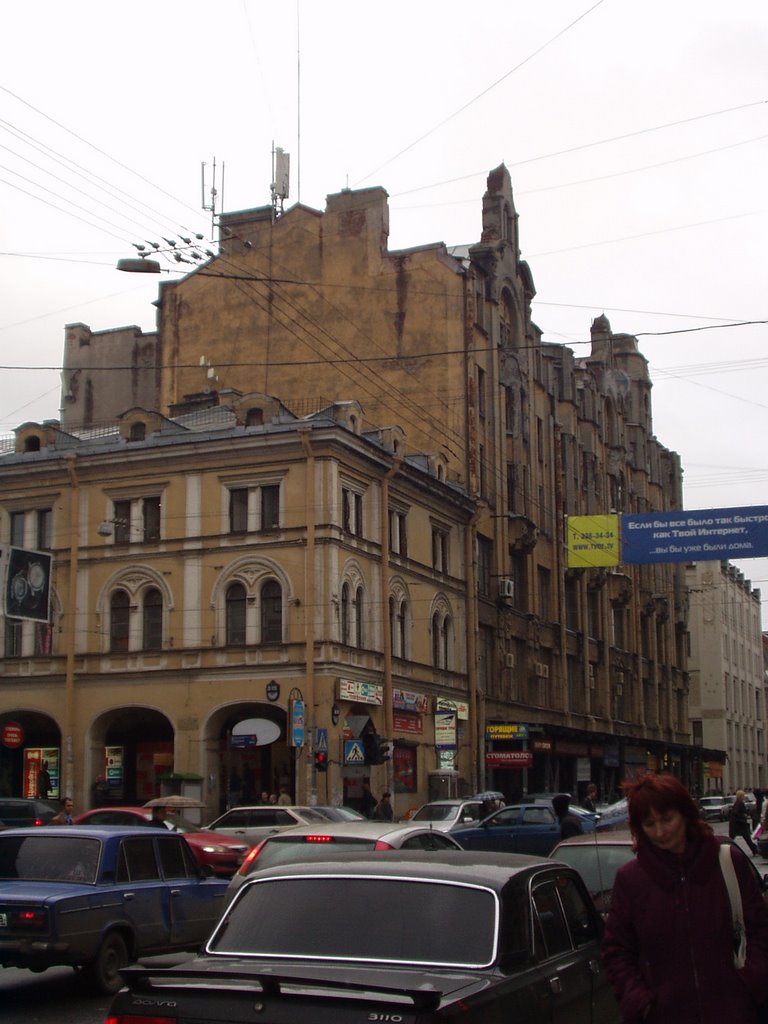
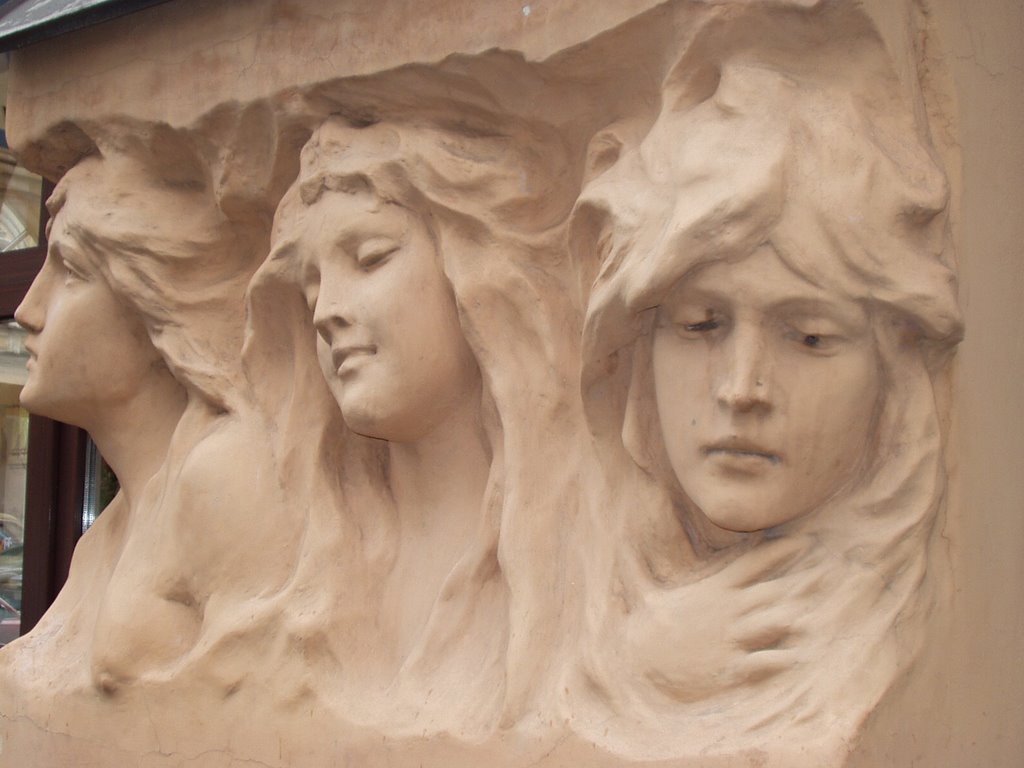
First, faces sculpted into the facade of a building where Sbarro pizza is located... A view along the Fontanka canal... And sunset west of Vasilievsky Island. If you look closely, you can see the evening traffic along the embankment.

Pictures for Daily Life in October, Part 1


First, me enjoying the autumn colors from a bench in my favorite park. Second: imperial details on a rare sunny day. Third, the dark facade of Apraskin Yard.

Daily life in October

After a slow period about two weeks ago, the pace of my interviewing is picking up, and I’m also beginning to really enjoy my city life. It’s especially fun when I am able to walk to the place where I need to meet someone. I did this twice last week – I live about 10 minutes on foot from the office of the Committee on City Planning and Architecture, and about 17 minutes from the 19th century palace where the City Legislative Assembly has its sessions. Once again I feel grateful to live in the center, because I get to know new areas of the city. I try to walk on routes that avoid streets with heavy traffic, and I try to cross footbridges and walk along canals as often as possible (I’ll include a picture I took last week). I live near the heart of 19th century architecture, so there’s lots to look at. One of my favorite views is of the somewhat dilapidated lower-class market Apraksin Yard. Its false façade rises high above the street and always makes me think of Dostoevsky, whose Crime and Punishment took place right in this neighborhood. In fact, an acquaintance took me to several “Dostoevsky” locations after an interview I did late last week. We went to the courtyard where Sonia, the novel’s heroine lived; her window looked out into a yellow wall, since the courtyard narrows right there and ends in a point. You can no longer get into the courtyard of the building where Raskolnikov “lived” – there’s a gate across it with a code. Good thing my friend Olga took me there about 10 years ago, although I can’t say there was much to see. I remember it was pretty striking, though, to realize how small his room actually was.

When I am not in too much of a hurry to get somewhere, I like to walk. I feel like I’m at least getting somewhere… Last Wednesday evening I had to travel the entire length of the main part of Nevsky in order to meet up with a friend, and it took me an hour because I tried to take a bus. I should have just walked the whole way! There are no traffic jams on the metro, and a pedestrian can always get through. Among people I interview who drive, the main lament is always the constant traffic jams around the city. Sometimes people are surprised to learn that we have the same problem in most of our cities! Here, the problem results mostly from poor infrastructure: narrow or bad roads, ineffective traffic light rhythms, and inexperienced (or desperate) drivers. There are about 250 cars per 1000 population, parking is almost nonexistent, and there are already serious problems. In the next five years the specialist that I talked to anticipates a doubling of the number of cars per 1000 people. Meanwhile, there isn’t really any need to persuade residents to take public transportation. The main metro lines are frequently packed, with various swarming patterns near the escalators, at the doors to the trains, and at the entrance to certain stations. People would use buses more if they ran more frequently, and if they didn’t get into traffic jams along with all the other vehicles. I still like above-ground public transportation such as buses and streetcars, but they are definitely at the bottom of the transportation totem pole.

On Friday evening I walked home from a seminar I attended on the eastern edge of the city center, and since it was late and I had no plans I decided to spoil myself: I went into Sbarro Italian Eatery near my apartment, and order two slices of pizza and a bottle of Lipton iced tea. As always with such efforts, it didn’t quite work: the pizza had sat too long under a lamp and the half-liter of tea kept me awake for hours. But I also took home a slice of “American cheesecake” and watched TV for a while.

The building in which Sbarro is located has beautiful women’s heads built into the façade. It is often very strange to see Western restaurant chains that I think of as inelegant or second-tier located in these grand old buildings. McDonald’s has that effect on me often; you get the feeling that it’s a chic meeting place here, as is Pizza Hut. Kentucky Fried Chicken has a restaurant right near the Subway on the lower part of Nevsky (Petersburg’s answer to Fifth Avenue) – right across from chic fashion boutiques. My Chinese friend likes going to KFC.

My visiting of Chinese restaurants is going somewhat slowly, more slowly than it should. But I lost heart after a couple of mediocre experiences. A longtime Chinese resident of Petersburg recently told me that Chinese food here is pretty authentic, but I’m sure it still depends where you eat… Fortunately for my research, I had lunch at a really good place last Wednesday. The tofu with green onions was excellent, as was the soup with seaweed and fried eggs. While I was there, a whole group of Chinese visitors came in (tourists? business travelers?) and had a quick lunch – a good indicator! The portions were so huge that I took home 2/3 of the tofu and left behind about a half gallon of soup. I’ll have to get someone to agree to go with me on my next outing. The local yellow pages include 85 Chinese restaurants, but the man I interviewed said that there are at least 150. I’ll try eventually to find out when they were opened.

I think I’m over halfway to my departure. It’s hard to remember the hot days when I first arrived. It’s still not too cold, but cold enough to wish that the central heating would come on in my building too… “Central heating” in most of Russia means a system of pipes that run steam to radiators in each room of apartments all over the city. You can’t control when it comes on, and you can’t regulate the temperature except by wearing a t-shirt or opening a window; you also can’t control when they periodically turn it off (to save some money). The system “gives heat” in a gradual way, and they haven’t gotten around to my building yet… So far I’m OK, but I look forward to the morning when I can put my hand to the big heavy metal radiators and warm myself up. Meanwhile, there’s always tea and jumping jacks.

A political commentary

A long time has gone by for several reasons. First, the last time I tried to write I was very upset about the situation in Georgia and several conversations with Russian acquaintances about Americans. Second, I panicked about my research and got very involved with that. But so much has happened, and I finally have a quiet day. So here is the “political” entry, including comments about the Russian-Georgian conflict, “ethnic” violence in Kondopoga, and the murder of Anna Politkovskaia.

I’ll repost some of an entry that I wrote in great indignation at the end of September. As commentary to that entry, I would like to point out that another country’s nationalism is very apparent to a visitor, whereas the nationalism of one’s own country seems to disappear into the natural order of things while one lives at home. I like “nationalism” and “patriotism” (as they are typically understood) less and less all the time, and I hope people in every country can relate to those concepts more gently and more creatively. As I wrote in my September 30 Georgia entry, it is annoying to see how much one country’s nationalistic rhetoric resembles another.

Someone sent me a Washington Post editorial about how Russia was oppressing poor democratic Georgia, and those big bad Russians once again are making the world unsafe for democracy. I will write about Politkovskaia in a minute, but first I want to suggest some local reasons why Russians don’t see it that way. To understand the reasons, you have to remember that Abkhazia (a piece of “Georgia” in the northwest right on the border with Russia) wants to be independent of Georgia and also that Russia has military forces on a base there (someone correct me?) that the Abkhazians don’t mind having as a buffer.

First, perhaps most trivially at first glance, Russians used to take their vacations in Georgia and Abkhazia in the days of the USSR. Lots of people have personal memories of being there, but now take their warm-climate vacations in Turkey and Tunisia because it is safer, cheaper, and less hassle (both countries make it easy for Russians to get visas, whereas Georgia does not). Lots of people that I talked to regret the fact that they can’t go there anymore, and feel a little possessive about it.

Second, people in Abkhazia are not all that happy with Georgia. They wanted to be independent too, and Georgia demonstratively does not want that; the Georgian government is unhappy with Russia because the latter has supported Abkhazian claims to autonomy. So you could be cynical about Russia’s position (it is certainly to their advantage that Abkhazia is not happy with Georgia), but you also have to accept that lots of Abkhazians are genuinely grateful for the support. The president of Abkhazia has made official request to the Russian parliament for support.

Third, things are not going all that well in Georgia. A significant portion of the population lives in poverty or near poverty, and the government can’t provide electricity all the time. Saakashvili (the president, who was educated in the West and has a European wife) likes to say that everything is wonderful, but apparently it isn’t. A lot of Georgia’s real income comes from family members who travel to Russia to work and send home part of their earnings. Some commentators think that Saakashvili ratcheted up the volume on this conflict in order to distract people’s attention. (That’s an old trick, yes?)

The average person in Russia loves Georgia. They love Georgian food, Georgian singing, Georgian romance and openness. I read lots of columns criticizing thick-headed politicians for making too big a fuss over the whole thing, and backing themselves into a corner where they have to use more and more severe measures or else lose face. I hear comments about this situation all the time along the lines of “it’s just the politicians fighting, the peoples of Russia and Georgia don’t want to quarrel.”

A lot of people here will say that Russians are nationalist, or perhaps racist, and I think in general that could be true. I’m not sure they are any more nationalist than any other people; maybe it’s the contrast between the high level of education and prejudice that makes it seem like Russians take the prize. But in many ways it’s a stereotype with a strength of its own. For instance, Kondopoga. This town in the Karelian (Finnish) part of Russia northwest of here was the scene of a riot and then a big anti-foreigner meeting at the very end of August. I read lots of pieces about this warning about the deep racism in Russian society; lots of Russians even wrote that. But Friday afternoon I heard a lecture given by a young sociologist who went there two weeks later to try to understand what had happened. He said it was hard to learn any more than was already available from the internet and newspapers, and that he already knew all the versions of the situation from those sources. His experience did, however, lead him to believe that the conflict was not about ethnicity as much as it was about drunkenness and local loyalties (someone in the pub at the wrong time – 3am), and certainly did not lead him to believe reports that some kind of Chechen mafia controlled the local market. His main conclusion was that people with various motives have been using this situation ever since for their own purposes (whether to constrain Chechens and Georgians in other markets, or to prove that Russians are racists), and that the residents of the town itself were surprised at how much press the incident garnered in succeeding days. It seemed to him that the mainstream Russian media is on the lookout for proof that the country could explode any day into ethnic conflict, and latch onto any evidence that presents itself. He also suggested that today’s Russian “nationalists” speak about democracy in a way that they didn’t in the 1990s (without irony), and that they are trying to gain access to public discourse about power structures and decision-making. So, I won’t suggest that this means that the picture is rosy, but it does mean that it’s more complicated.

Right about the same time, Andrei Kozlov was shot down in Moscow – a deputy minister for something to do with economic reform. At the time, I remember thinking that that was the more serious incident, and the murder a week ago of Anna Politkovskaia confirms that impression. As several journalists here have written, the fact that so many prominent journalists and officials have been murdered since Putin came to power points to several things. Among them is the sense that Russian society is not governed by respect for law. We sort of knew that – we assume that American society, as British society before it, is based on laws and respect for them. The murders of Kozlov and Politkovskaia, again as several people have written, suggest that a group of people close to power believe that violence is a good way to resolve situations, and that people who irritate the system should just be removed. That’s much more chilling that Kondopoga.

An acquaintance of mine made the comment a while ago that most people in Russian society have little experience with compromise. Partly this is due to the historical belief that final decisions should be unanimous; that everyone should agree; that the person in charge channels the agreement of the whole; thus that if you disagree, you are going against the interests of the whole and become dangerous. If you listen to what Putin said about Politkovskaia while he was in Germany, you see that he didn’t speak about her work: he called her a mother and a wife, and that it was criminal to kill such people. Subtext: her place really was at home as a wife and mother, and if she had been doing her part to further the collective interests of Russian society this wouldn’t have happened. (And by the way, we’ll look into it a little bit.) The emphasis on collectivity of political will and thought goes very deep. Someone else remarked to me recently that if a Russian were to examine the US Constitution and see how many powers are allowed to the states, he would be sure that the US would fall apart tomorrow. Thus, partly, the belief that Russia shouldn’t really be a federation (which is what has happened in practice: it isn’t).

Much as I have always wanted to be more positive than negative about what is going on here, things are definitely seriously troubling. But this is the work of part of the population, and most of the folks that I am meeting are amazing examples of people trying to work within the space that is left to make new possibilities for themselves and other people. So, if you find yourself remarking out loud about the “Russians,” it might be worth substituting “the Russian power elite” or at least “the Russian government.”